Table of Contents
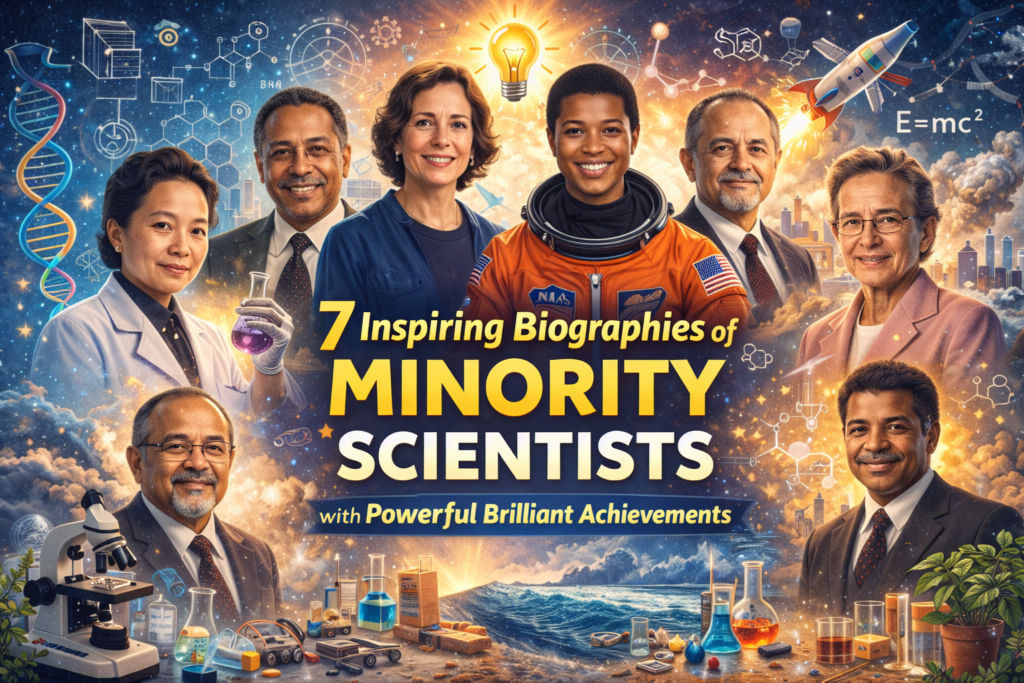
Toggle7 Inspiring Biographies of Minority Scientists with Powerful Brilliant Achievements
Science has been shaped by brilliant minds from many different backgrounds. Reading biographies of minority scientists helps students understand how perseverance, creativity, and determination can lead to groundbreaking discoveries.
Many innovators faced social and educational barriers yet still made remarkable contributions to science, engineering, and medicine. The stories in these biographies of minority scientists highlight how talent and passion can overcome challenges.
In this article, we explore inspiring examples that continue to motivate students, researchers, and future innovators.
Why Biographies of Minority Scientists Matter
Learning about diverse scientists encourages more students to explore STEM careers. Biographies of minority scientists demonstrate that scientific success can come from any background.
These stories also reveal how different perspectives help solve complex global problems.
According to educational research discussed by
https://www.scientificamerican.com , representation in science improves innovation and inspires more students to pursue STEM careers.
Because of this impact, biographies of minority scientists are important educational resources.
1. George Washington Carver – Agricultural Science Pioneer
One of the most famous biographies of minority scientists is the story of George Washington Carver.
Carver developed innovative farming techniques and promoted crop rotation to improve soil health. His research helped farmers increase productivity and sustainability.
Beyond agriculture, he created hundreds of products from peanuts and other crops.
His dedication to scientific research and education continues to inspire future scientists.
2. Katherine Johnson – NASA Mathematics Legend
Katherine Johnson’s story is among the most inspiring biographies of minority scientists in space exploration.
Her mathematical calculations helped NASA launch astronauts safely into orbit. She played a key role in early space missions that advanced human space travel.
Johnson’s work proved that determination and intelligence can break barriers in science.
3. Ellen Ochoa – Engineer and Astronaut
Ellen Ochoa became the first Hispanic woman in space.
Her biographies of minority scientists story includes important engineering research and leadership at NASA.
Ochoa later served as director of the Johnson Space Center, inspiring thousands of students interested in engineering and space science.
4. Percy Julian – Chemical Research Innovator
Percy Julian was a brilliant chemist whose work revolutionized the pharmaceutical industry.
His biographies of minority scientists story includes discovering ways to synthesize medicinal compounds used in treatments for glaucoma and arthritis.
Despite facing discrimination, Julian became one of the most respected chemists of his time.
5. Mae Jemison – Scientist and Astronaut
Mae Jemison’s story is one of the most inspiring biographies of minority scientists in modern STEM.
She became the first African American woman to travel to space in 1992.
Jemison continues to promote science education and encourage young students to pursue STEM careers.
6. Chien-Shiung Wu – Nuclear Physics Pioneer
Chien-Shiung Wu made major contributions to nuclear physics and experimental science.
Her biographies of minority scientists achievements include groundbreaking work that challenged long-standing physics theories.
Wu’s research helped reshape our understanding of particle physics.
7. Mario Molina – Environmental Chemistry Leader
Mario Molina was a Nobel Prize–winning chemist whose research helped reveal the dangers of ozone depletion.
His biographies of minority scientists story highlights how scientific research can protect the environment and influence global policy.
His work helped lead to international agreements that reduced harmful chemicals damaging the ozone layer.
You can explore more scientific discoveries at
https://www.nationalgeographic.com/science .
How Minority Scientists Inspire Future Generations
The stories shared in biographies of minority scientists show that determination and curiosity can overcome obstacles.
These scientists not only made groundbreaking discoveries but also inspired countless students to pursue careers in science and technology.
Teachers and parents can use these stories to encourage young learners to explore STEM subjects.
If you want more inspiration for students, read our article about:
STEM role models for students:
https://styles-bio.com/stem-education-for-kids/
Learning about inspiring scientists helps students imagine themselves contributing to future discoveries.
Encouraging Diversity in STEM
Increasing diversity in science leads to stronger research and new ideas. Biographies of minority scientists highlight the importance of equal opportunity in education and research.
Schools, universities, and organizations are working to support young scientists from diverse backgrounds through scholarships, mentorship programs, and STEM initiatives.
By sharing these stories, educators can inspire the next generation of innovators.
Frequently Asked Questions (FAQ)
What are biographies of minority scientists?
Biographies of minority scientists are stories about scientists from underrepresented backgrounds who made significant contributions to science and technology.
Why are minority scientists important in STEM?
They bring diverse perspectives that help solve complex problems and improve scientific innovation.
Who are some famous minority scientists?
Examples include Katherine Johnson, George Washington Carver, Mae Jemison, Percy Julian, and Mario Molina.
How can students learn from minority scientists?
Students can read biographies, watch documentaries, and participate in science projects inspired by these innovators.
Why should schools teach biographies of minority scientists?
Teaching these stories helps promote diversity, inspire students, and highlight the global impact of scientific research.