Table of Contents
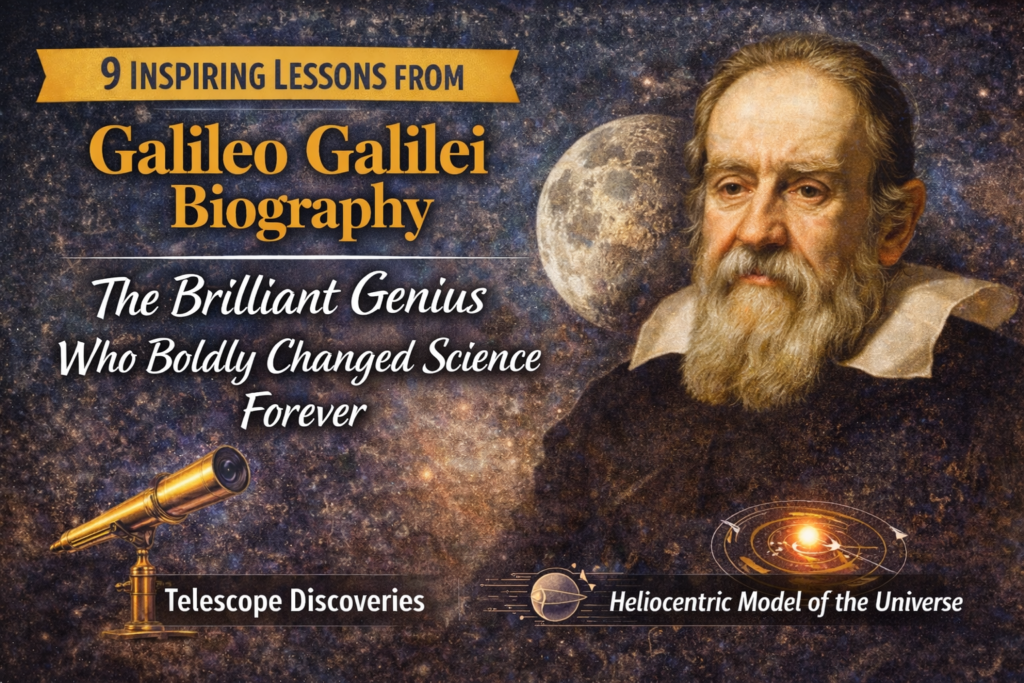
Toggle9 Inspiring Lessons from Galileo Galilei Biography: The Brilliant Genius Who Boldly Changed Science Forever
The Galileo Galilei biography is one of the most fascinating stories in the history of science. When people explore the Galileo Galilei biography, they discover the life of a fearless thinker who challenged traditional beliefs and changed humanity’s understanding of the universe. The Galileo Galilei biography shows how curiosity, courage, and persistence helped create the foundation of modern astronomy.
Often called the “father of modern science,” Galileo introduced new ways of observing the cosmos. The discoveries highlighted throughout the Galileo Galilei biography helped shift science from speculation to observation and experimentation.
Early Life in the Galileo Galilei Biography
The Galileo Galilei biography begins on February 15, 1564, in Pisa, Italy. In the early chapters of the Galileo Galilei biography, Galileo grew up in a family that valued education, music, and intellectual curiosity.
His father, Vincenzo Galilei, was a musician and scholar who encouraged independent thinking. According to historians studying the Galileo Galilei biography, this environment played a key role in shaping Galileo’s scientific mindset.
During his youth described in the Galileo Galilei biography, Galileo showed strong interest in mathematics and mechanical devices. He was fascinated by how objects moved and how natural laws governed the world.
These early curiosities marked the beginning of the scientific journey described in the Galileo Galilei biography.
Education and Early Scientific Work
Another important stage in the Galileo Galilei biography was his education at the University of Pisa. Initially, Galileo studied medicine, but the Galileo Galilei biography shows that his passion soon shifted toward mathematics and physics.
While studying motion and gravity, Galileo began questioning long-accepted scientific ideas. The Galileo Galilei biography explains how he performed experiments to understand how objects fall and move.
One famous observation mentioned in the Galileo Galilei biography involved studying pendulums in a cathedral. Galileo noticed that the swing of a pendulum remained consistent regardless of its size.
This insight later influenced developments in timekeeping and physics.
The Telescope Revolution
One of the most exciting chapters in the Galileo Galilei biography involves the telescope.
In 1609, Galileo improved an existing telescope design and began observing the night sky. The discoveries described in the Galileo’s inspiring life story changed astronomy forever.
Using his telescope, Galileo observed:
- Mountains and craters on the Moon
- Moons orbiting Jupiter
- Phases of Venus
- Countless previously unseen stars
These observations in the Galileo’s inspiring life story provided strong evidence that the universe was far more complex than previously believed.
Most importantly, Galileo’s work supported Copernicus’s theory that the Earth revolves around the Sun.
The Telescope Revolution
One of the most exciting chapters in the Galileo’s inspiring life story involves the telescope.
In 1609, Galileo improved an existing telescope design and began observing the night sky. The discoveries described in the Galileo’s inspiring life story changed astronomy forever.
Using his telescope, Galileo observed:
- Mountains and craters on the Moon
- Moons orbiting Jupiter
- Phases of Venus
- Countless previously unseen stars
These observations in the Galileo’s inspiring life story provided strong evidence that the universe was far more complex than previously believed.
Most importantly, Galileo’s work supported Copernicus’s theory that the Earth revolves around the Sun.
Scientific Contributions of Galileo
The Galileo Galilei biography includes numerous scientific achievements that shaped modern science.
Some of the most important contributions highlighted in the Galileo’s inspiring life story include:
- Improvements to the telescope
- Discovery of Jupiter’s moons
- Observations supporting heliocentrism
- Research on motion and falling objects
- Early foundations of experimental physics
The discoveries discussed in the Galileo’s inspiring life story helped establish observation and experimentation as essential tools in science.
Galileo’s Lasting Legacy
The final chapters of the Galileo Galilei biography reveal a legacy that continues to influence science centuries later.
Galileo died on January 8, 1642, but the discoveries described in the Galileo’s inspiring life story remain fundamental to modern astronomy and physics.
His work influenced later scientists such as Isaac Newton, whose laws of motion built upon ideas first explored in the Galileo Galilei biography.
Today, Galileo is remembered as a pioneer who helped humanity understand the true structure of the universe.
👉 Isaac Newton Biography and Inventions – The Brilliant Genius Who Transformed Science Forever
https://www.britannica.com/biography/Galileo-Galilei
Quick Facts from the Galileo Galilei Biography
- Born: February 15, 1564
- Birthplace: Pisa, Italy
- Famous for: Telescope discoveries and astronomy
- Major discovery: Moons of Jupiter
- Died: January 8, 1642
FAQ (SEO Rich Results)
Who was Galileo Galilei?
Galileo Galilei was an Italian astronomer and physicist known for improving the telescope and supporting the heliocentric model of the solar system.
Why is Galileo Galilei famous?
Galileo became famous for his astronomical discoveries and for helping establish the scientific method based on observation and experimentation.
What did Galileo Galilei discover?
Galileo discovered the four largest moons of Jupiter, studied the phases of Venus, and made detailed observations of the Moon.
Why was Galileo Galilei put on trial?
Galileo was tried by the Roman Inquisition because he supported the heliocentric theory that the Earth revolves around the Sun.