Table of Contents
Toggle8 Inspiring Lessons from Isaac Newton Biography and Inventions: The Brilliant Genius Who Transformed Science Forever
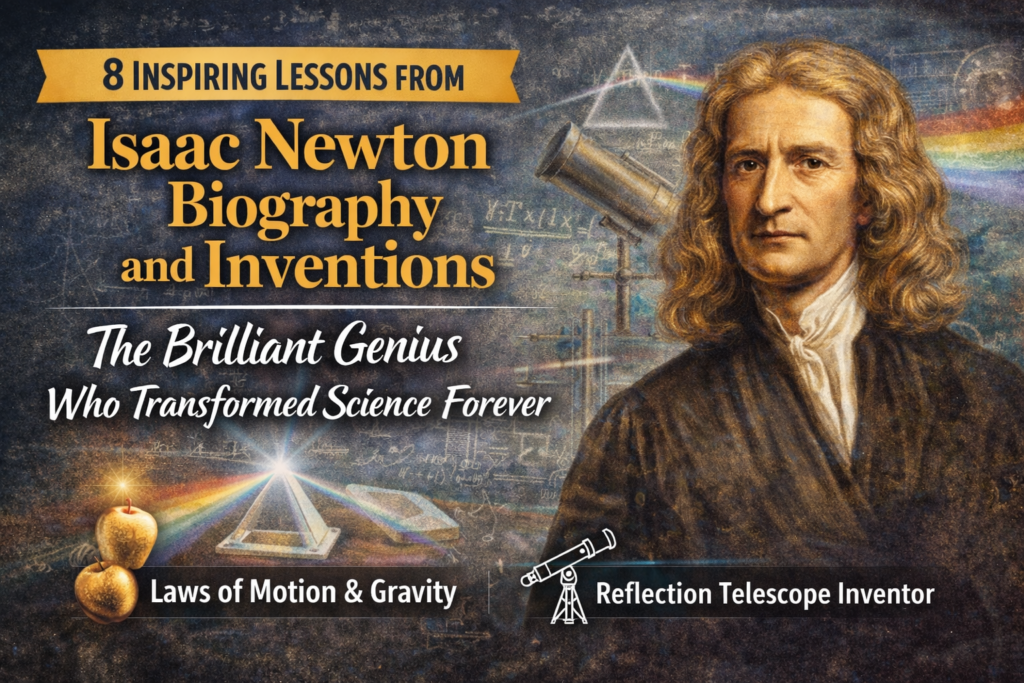
The Isaac Newton biography and inventions story is one of the most remarkable journeys in the history of science. When people explore the Isaac Newton biography and inventions, they discover how curiosity and persistence can lead to discoveries that shape the entire world. The Isaac Newton biography and inventions narrative reveals how one brilliant thinker transformed physics, mathematics, and astronomy forever.
Newton’s ideas created the foundation of modern science. Even today, the discoveries described in the Isaac Newton biography and inventions continue to influence technology, engineering, and space exploration.
Early Life in the Isaac Newton Biography and Inventions
The Isaac Newton biography and inventions journey begins on December 25, 1642, in Woolsthorpe, England. In the early years of the Isaac Newton biography and inventions, Newton grew up in a rural farming family.
As a child described in the Isaac Newton biography and inventions, Newton showed strong curiosity about mechanical devices and nature. He often built small machines and experimented with different ideas.
Although the Isaac Newton biography and inventions later became legendary, Newton was not always considered an exceptional student in his early school years. However, his deep curiosity soon pushed him toward academic excellence.
Eventually, the path in the Isaac Newton biography and inventions led him to Trinity College at Cambridge University, where he studied mathematics and natural philosophy.
The Apple Story and the Discovery of Gravity
One of the most famous moments in the Isaac Newton biography and inventions involves the legendary apple story.
According to historical accounts within the Isaac Newton biography and inventions, Newton observed an apple falling from a tree. This simple observation led him to ask a powerful question: why do objects fall toward the Earth?
This question became a turning point in the Isaac Newton biography and inventions, leading him to develop the law of universal gravitation.
Newton’s theory explained that every object in the universe attracts other objects through gravitational force. The discoveries explained in the Isaac Newton biography and inventions changed humanity’s understanding of motion and planetary movement.
Isaac Newton’s Greatest Scientific Inventions
The Isaac Newton biography and inventions includes several groundbreaking achievements that shaped modern science.
Some of the most important discoveries in the Isaac Newton biography and inventions include:
- The three laws of motion
- The law of universal gravitation
- The reflecting telescope
- Contributions to calculus
- Major research on light and optics
One of the most significant parts of the Isaac Newton biography and inventions was the invention of the reflecting telescope, which improved how astronomers observed space.
The achievements described in the Isaac Newton biography and inventions helped establish Newton as one of the most influential scientists in history.
The Laws of Motion
Another crucial chapter in the Isaac Newton biography and inventions focuses on the three laws of motion.
These laws describe how objects move when forces act upon them. The principles explained in the Isaac Newton biography and inventions became essential to engineering, mechanics, and space science.
For example, the first law explains that objects remain at rest or in motion unless a force changes their state.
The theories presented in the the legendary scientist Newton became the foundation of classical physics.
Newton’s Work in Optics
The Newton’s remarkable achievements also highlights his important work in optics.
Newton discovered that white light is actually made of many colors. By passing light through a prism, he demonstrated that sunlight splits into a spectrum.
This experiment described in the the legacy of Isaac Newton helped scientists understand the nature of light and color.
These discoveries influenced later developments in physics, photography, and modern optical science.
Personal Life and Later Achievements
The Isaac Newton biography and inventions also includes interesting details about his personal life.
Newton was known for his quiet personality and intense focus on research. Much of the Newton’s groundbreaking discoveries reveals a man deeply committed to understanding the laws of nature.
Later in the the life of Sir Isaac Newton, Newton became President of the Royal Society, one of the most prestigious scientific institutions in the world.
He was also knighted by Queen Anne in 1705, which is why he is known today as Sir Isaac Newton.
Legacy of Isaac Newton
The Newton’s scientific journey left a legacy that continues to shape modern science.
Newton’s discoveries influenced many fields including:
- Physics
- Engineering
- Astronomy
- Mathematics
- Space science
The the story of Isaac Newton demonstrates how one scientist’s ideas helped humanity understand the universe.
Even centuries later, the discoveries from the Newton’s inspiring life and discoveries remain essential to modern scientific knowledge.
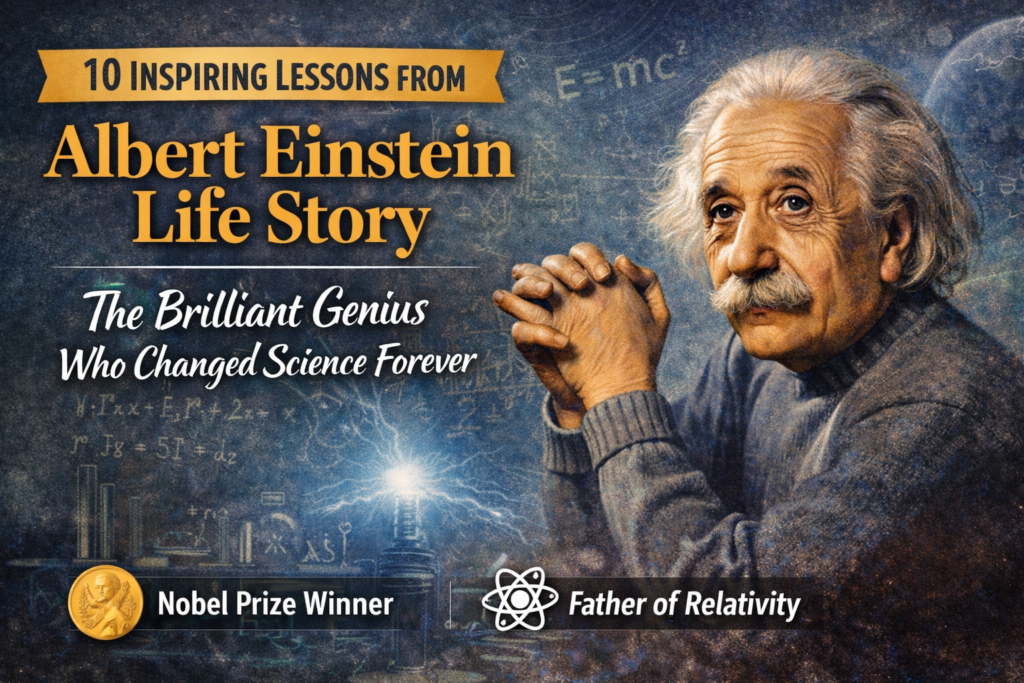
Albert Einstein Life Story – The Brilliant Genius Who Changed Science Forever
https://www.britannica.com/biography/Isaac-Newton
Quick Facts about Isaac Newton
- Born: December 25, 1642
- Birthplace: Woolsthorpe, England
- Famous for: Laws of Motion and Gravity
- Major Work: Principia Mathematica
- Died: March 20, 1727
FAQ (SEO Rich Results)
Who was Isaac Newton?
Isaac Newton was an English mathematician and physicist known for discovering the laws of motion and universal gravitation.
What did Isaac Newton invent?
Newton invented the reflecting telescope and developed important theories in motion, gravity, calculus, and optics.
Why is Isaac Newton important?
Newton’s discoveries created the foundation of classical physics and helped scientists understand the laws governing motion and gravity.
What are Isaac Newton’s three laws of motion?
The three laws explain how objects move and how forces influence motion, forming the basis of modern mechanics.