Table of Contents
ToggleMachine Learning
Machine learning is one of the most important technologies in modern computing. Businesses and researchers use machine learning to analyze data discover patterns and make predictions.
In simple terms machine learning is a method that allows computers to learn from data without being directly programmed for every task. Instead of writing detailed instructions developers train systems with data so they can improve automatically.
Today machine learning is used in search engines recommendation systems healthcare analytics fraud detection and many other digital services.
To understand the broader concept you can read our internal guide about what is artificial intelligence which explains how intelligent technologies work together.
Machine Learning Definition
Machine learning is a field of computer science that enables systems to learn from experience and improve performance through data analysis.
In traditional programming developers write rules for computers. With machine learning algorithms analyze datasets and discover patterns on their own.
Key characteristics
• Learning from data
• Pattern recognition
• Predictive modeling
• Automated decision making
• Continuous improvement
These characteristics make ML technology useful for solving complex problems where traditional programming is limited.
For a deeper explanation of AI technologies visit
https://www.ibm.com/topics/machine-learning
How Machine Learning Works
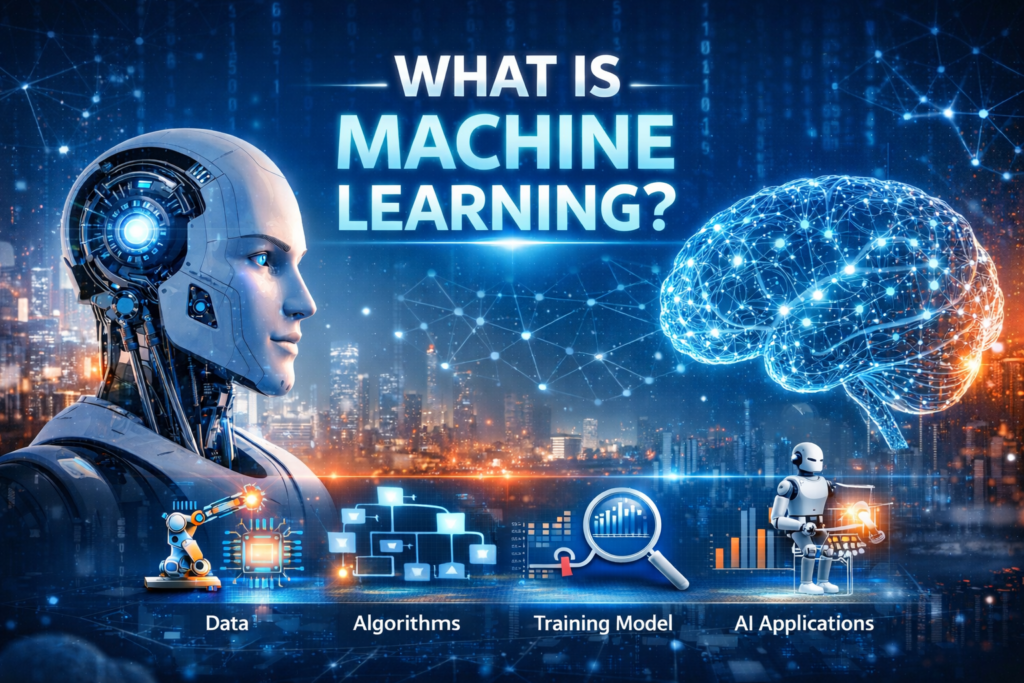
The basic idea behind ML technology is training algorithms using large datasets so they can recognize patterns and make predictions.
Steps in the learning process
1 Data collection
Information is gathered from various sources.
2 Data preparation
The dataset is cleaned and organized.
3 Model training
Algorithms analyze the training data and learn patterns.
4 Model evaluation
Accuracy is tested using new data.
5 Deployment
The trained model is used in real applications.
This process allows machine learning systems to improve their performance over time.
Learn More About :
what is artificial intelligence
Types of Machine Learning
Experts usually divide ML technology into three major categories.
| Type | Description | Example |
|---|---|---|
| Supervised learning | Uses labeled training data | Email spam detection |
| Unsupervised learning | Finds patterns in unlabeled data | Customer grouping |
| Reinforcement learning | Learns through reward feedback | Robotics control |
Supervised learning
In supervised learning the model is trained using labeled data where the correct output is already known.
Unsupervised learning
Unsupervised learning identifies hidden patterns in datasets without predefined labels.
Reinforcement learning
Reinforcement learning teaches systems through rewards and penalties to achieve the best results.
More technical details about learning models can be explored here
https://cloud.google.com/learn/what-is-machine-learning
Machine Learning Algorithms
Different algorithms help computers learn from data effectively.
Common algorithms
• Linear regression
• Logistic regression
• Decision trees
• Random forests
• Support vector machines
• Neural networks
Each algorithm is designed for different prediction tasks and data types.
Applications of Machine Learning
Many industries rely on ML technology to improve efficiency and decision making.
Major applications
Search engines
Search engines use ML technology to rank pages and understand user queries.
Healthcare analytics
Medical systems analyze patient data to assist diagnosis.
Fraud detection
Financial institutions detect suspicious activity using predictive models.
Recommendation systems
Streaming platforms suggest movies and music based on user behavior.
Autonomous vehicles
Self driving systems rely on ML technology for object detection and navigation.
You can also explore our guide about real world AI applications to see how intelligent systems work in everyday life.
Benefits of Machine Learning
Organizations use ML technology because it provides many advantages.
Key benefits
• Faster data processing
• Accurate predictions
• Automation of complex tasks
• Better business insights
• Improved customer experiences
These benefits make ML technology a powerful tool for modern data driven industries.
Challenges of Machine Learning
Despite its advantages ML technology also has several limitations.
Common issues
• Need for large datasets
• Data quality problems
• Model bias
• High computational requirements
• Difficulty interpreting complex models
Researchers continue improving algorithms and training methods to solve these challenges.
Future of Machine Learning
The future of ML technology looks extremely promising. As computing power increases and data availability grows new breakthroughs will appear.
Machine learning will continue transforming industries such as healthcare finance transportation cybersecurity and scientific research.
Advances in deep learning neural networks and data processing will expand the potential of ML technology technologies in the coming years.
Conclusion
ML technology is a powerful technology that allows computers to learn patterns from data and improve performance without manual programming. By analyzing large datasets algorithms can make predictions automate processes and solve complex problems.
Today predictive models powers search engines recommendation systems fraud detection and many other technologies used in daily life. As research progresses predictive models will continue shaping the future of digital innovation.
Understanding predictive models is essential for anyone interested in modern technology and data driven solutions.
FAQ
What is ML technology in simple words
Machine learning is a technology that allows computers to learn from data and improve their performance automatically.
Why is ML technology important
It helps analyze large datasets automate processes and improve predictions.
What are examples of ML technology
Examples include recommendation systems spam filters voice assistants and fraud detection.
Is ML technology part of artificial intelligence
Yes machine learning is a subset of artificial intelligence focused on learning from data.
Which industries use ML technology
Healthcare finance transportation retail and cybersecurity widely use machine learning.