Table of Contents
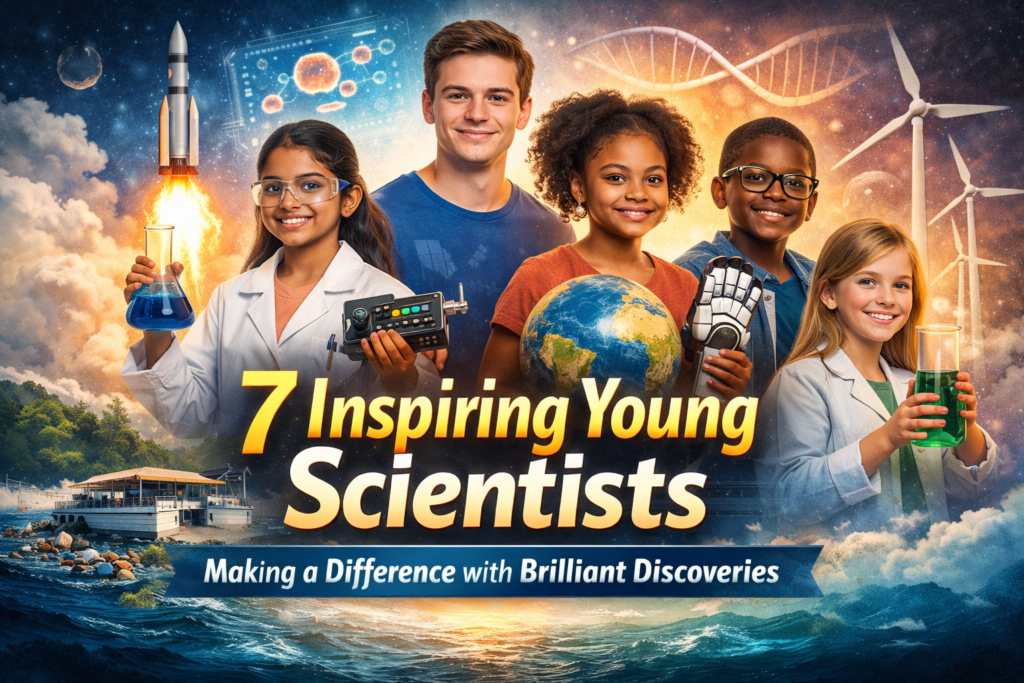
Toggle7 Inspiring Young Scientists Making a Difference with Brilliant Discoveries
Science is often associated with experienced researchers and large laboratories, but many young scientists making a difference are proving that age does not limit innovation. Around the world, young minds are solving real problems, developing new technologies, and inspiring the next generation of researchers.
These talented individuals are showing that curiosity and creativity can lead to powerful breakthroughs. In this article, we explore how young scientists making a difference are transforming science and why their contributions matter more than ever.
Why Young Scientists Matter in Modern Research
The scientific world thrives on fresh perspectives. Many discoveries begin with simple questions asked by curious minds. Today, young scientists making a difference are bringing new ideas and creative approaches to complex challenges.
Young innovators often focus on real-world problems such as climate change, medical research, renewable energy, and environmental protection. Their projects show that even small experiments can lead to powerful solutions.
According to research shared by
https://www.scientificamerican.com , early engagement in science significantly increases innovation and long-term research impact.
When students explore science early, they develop skills in problem solving, critical thinking, and creativity.
1. Gitanjali Rao – Fighting Water Contamination
One of the most well-known examples of young scientists making a difference is Gitanjali Rao. She created a device that detects lead in drinking water using carbon nanotube sensors.
Her invention helps communities identify contaminated water quickly and safely.
The technology is simple, portable, and affordable, which makes it useful in areas where advanced laboratories are unavailable.
Her work demonstrates how young scientists making a difference can create solutions that directly improve public health.
2. Boyan Slat – Cleaning the Oceans
Boyan Slat started working on ocean pollution solutions as a teenager. His project, The Ocean Cleanup, aims to remove plastic from the world’s oceans.
Although his work now involves a large organization, the idea started with a young student who believed environmental problems could be solved with engineering.
Stories like his highlight how young scientists making a difference can tackle global environmental challenges.
More environmental science innovations are regularly covered by
https://www.nationalgeographic.com/science ,
3. Deepika Kurup – Solar Powered Water Purification
Deepika Kurup developed a solar-powered water purification system when she was only 14 years old.
Her system uses sunlight to eliminate harmful bacteria in contaminated water.
This invention helps provide safe drinking water in developing regions.
Projects like this show how young scientists making a difference can create affordable solutions to global health problems.
4. Jack Andraka – Early Cancer Detection
Jack Andraka created a groundbreaking method for detecting pancreatic cancer at an early stage.
His test is faster and much cheaper than traditional diagnostic methods.
Medical researchers praised his work for its potential to improve survival rates for one of the deadliest cancers.
This is another powerful example of young scientists making a difference in medical science.
5. Hannah Herbst – Renewable Energy Innovation
Hannah Herbst designed a small generator that converts ocean current movement into renewable energy.
Her project aimed to help power underwater sensors used in ocean research.
Renewable energy innovation from young scientists making a difference like Hannah helps scientists collect data without relying on expensive equipment.
6. Shubham Banerjee – Low Cost Braille Printer
Accessibility technology has also benefited from young scientists making a difference.
Shubham Banerjee invented an affordable Braille printer made from LEGO parts.
Traditional Braille printers can cost thousands of dollars, making them difficult to access.
His design dramatically reduces the cost, helping visually impaired individuals access printed materials.
7. Kiara Nirghin – Fighting Drought with Super Absorbent Polymer
Kiara Nirghin developed a biodegradable material that helps soil retain water during drought conditions.
Farmers can use this technology to protect crops during dry seasons.
Agricultural innovation like this demonstrates how young scientists making a difference can contribute to food security and environmental sustainability.
How Young Innovators Are Changing the Future
The achievements of these individuals prove that innovation can start at any age. Encouraging scientific curiosity in schools and communities allows more young scientists making a difference to develop their ideas.
Mentorship, access to resources, and exposure to real-world challenges are essential for nurturing future scientists.
If you want to help young learners explore science, you can also read our guide on
STEM education for beginners:
https://styles-bio.com/stem-education-for-kids/ .
Supporting young innovators today can lead to discoveries that shape tomorrow.
Frequently Asked Questions (FAQ)
What is a young scientist?
A young scientist is typically a student or early-career researcher who conducts experiments, develops new ideas, or contributes to scientific discovery.
Why are young scientists important?
Young scientists bring fresh ideas, creativity, and curiosity to research. Many breakthroughs come from innovative thinking that challenges traditional approaches.
How can students become young scientists?
Students can start by exploring science projects, participating in science fairs, joining STEM programs, and learning basic research methods.
Can young people really change science?
Yes. Many famous discoveries began with experiments by students. Today there are many examples of young scientists making a difference through innovation.
What fields do young scientists work in?
Young scientists work in many fields including medicine, environmental science, robotics, renewable energy, and technology.